The Professional Voice: A Comprehensive 2,000-Word Guide to Voice Therapy and Vocal Health for Career Longevity

Protecting Your Most Valuable Asset: Clarity, Endurance, and Authority
For professionals whose careers depend on their voice—teachers, executives, sales personnel, public speakers, and customer service representatives—the voice is not just a tool; it is a critical professional asset. When the voice falters due to strain, hoarseness, or fatigue, it can lead to missed opportunities, reduced productivity, and even career disruption. Maintaining vocal health is as essential as any other form of professional development.
At Clear Accent Speech Therapy, Jennifer Jourdain, M.S., a licensed speech-language pathologist with over 30 years of experience in adult rehabilitation, specializes in voice therapy designed to restore vocal function, enhance vocal endurance, and ensure your voice projects the authority and confidence your expertise deserves. This in-depth guide will explore the anatomy of a healthy voice, the common threats to vocal health, and the evidence-based techniques used in voice therapy to keep your professional voice strong and clear for years to come.
The Anatomy of Voice: How We Produce Sound
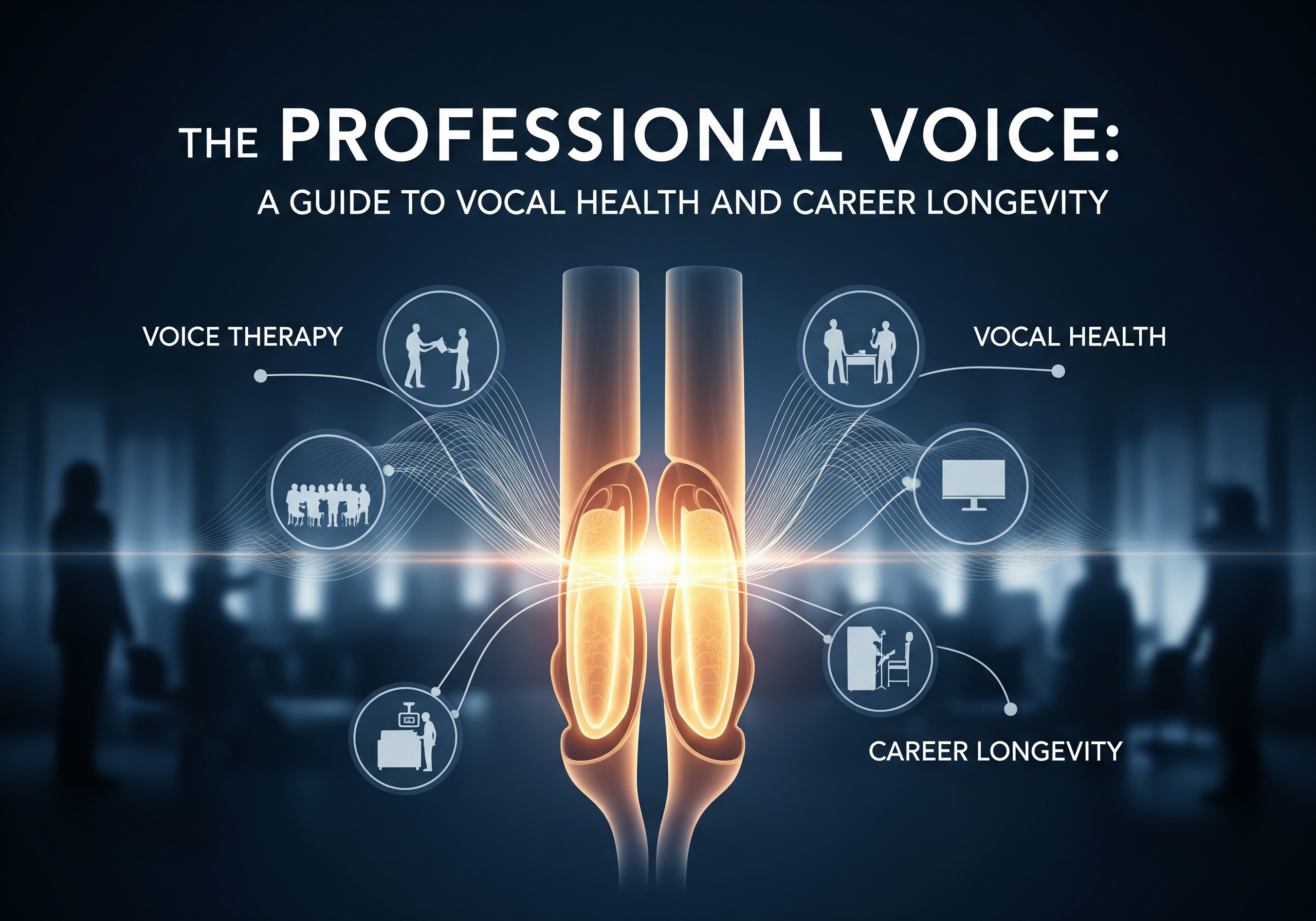
To understand vocal health, one must first appreciate the delicate mechanism of voice production, or phonation. The process involves three interconnected systems:
1. Respiration (The Power Source): The lungs provide the air pressure (breath support) necessary to vibrate the vocal folds. Proper diaphragmatic breathing is the foundation of a strong, healthy voice.
2. Phonation (The Sound Source): The vocal folds (often incorrectly called vocal cords) are two bands of muscle tissue housed within the larynx (voice box). When air passes over them, they vibrate rapidly, creating sound waves.
3. Resonance (The Amplifier): The sound waves travel up into the vocal tract (throat, mouth, and nasal cavities), which act as resonators, shaping and amplifying the raw sound into the unique quality of your voice.
When any of these three systems are out of balance—for example, poor breath support or excessive tension in the larynx—the voice can become strained, leading to a voice disorder.
Common Voice Disorders in Professionals
Voice disorders are often categorized by their cause. For professional voice users, the most common issues stem from vocal misuse or overuse:

The Voice Therapy Solution: Evidence-Based Techniques
Voice therapy, administered by a licensed Speech-Language Pathologist (SLP), is the gold standard for treating most functional voice disorders. Jennifer Jourdain’s approach focuses on physiologic voice therapy, which aims to balance the three subsystems of voice production (respiration, phonation, and resonance) to achieve the most efficient and least effortful voice possible [1].
Technique 1: Vocal Function Exercises (VFEs)
VFEs are a structured program designed to strengthen and coordinate the laryngeal muscles. They are often described as “physical therapy for the voice.”
The Goal: To improve the strength, flexibility, and endurance of the vocal folds.
The Practice: Involves four key exercises performed twice daily: sustained vowels, pitch glides, and sustained sounds on specific vowels, all performed softly and efficiently. VFEs help to stretch and contract the vocal folds without excessive force, promoting a healthy, balanced vibration.
Technique 2: Resonant Voice Therapy (RVT)
RVT is a highly effective technique that focuses on maximizing the use of the vocal tract’s natural resonators (the mouth and nose) to produce a clear, strong voice with minimal effort.
The Goal: To achieve a “forward focus” in the voice, where the sound is felt as a vibration in the mask of the face (lips, nose, cheeks).
The Practice: Clients practice producing humming sounds and specific phrases with an easy, forward-focused vibration. This technique trains the vocal folds to vibrate with less impact stress, which is crucial for healing vocal fold lesions like nodules.
Technique 3: Confidential Voice and Semi-Occluded Vocal Tract (SOVT) Exercises
These techniques are used to reduce the impact stress on the vocal folds, particularly during the healing phase.
Confidential Voice: Speaking in a soft, breathy voice (not a whisper) that minimizes vocal fold collision. This is a temporary technique used during acute injury or post-surgery.
SOVT Exercises: Using tools like straw phonation (singing or speaking through a straw into water) or lip trills. These exercises create back pressure in the vocal tract, which gently separates the vocal folds and allows them to vibrate more efficiently and with less force.
Technique 4: Respiratory Training and Diaphragmatic Support
The voice is only as strong as the breath that supports it. Voice therapy includes training in proper breathing mechanics.
Diaphragmatic Breathing: Teaching clients to engage the diaphragm and abdominal muscles for deep, controlled inhalation, rather than relying on shallow, upper-chest breathing. This provides a steady, controlled stream of air for sustained phonation.
Expiratory Control: Learning to manage the outflow of air to support long phrases and high-volume speaking without running out of breath or straining the voice.
Vocal Hygiene: The Daily Practice of Prevention
While voice therapy treats existing problems, vocal hygiene is the preventative maintenance that every professional voice user must practice daily.
1. Hydration: The Lubricant of the Voice
The vocal folds must be well-lubricated to vibrate smoothly. Dehydration leads to thicker mucus and increased friction, which can cause hoarseness and strain.
The Rule: Drink plenty of water throughout the day. Aim for six to eight glasses of water daily.
Avoid: Excessive caffeine and alcohol, which are diuretics and dehydrate the vocal folds.
2. Avoiding Vocal Misuse and Abuse
Certain behaviors are highly damaging to the vocal folds and must be eliminated.

3. Managing Environmental and Lifestyle Factors
Reflux Management: Gastroesophageal Reflux Disease (GERD) or Laryngopharyngeal Reflux (LPR) can cause stomach acid to irritate the vocal folds, leading to chronic hoarseness. Management often involves diet changes and medication, in coordination with a physician.
Rest and Recovery: Just like any muscle, the vocal mechanism needs rest. Schedule periods of vocal rest throughout the day, especially after periods of heavy voice use.
Warm-ups and Cool-downs: Perform gentle vocal warm-ups before high demand speaking and cool-downs afterward to prevent injury.
The Professional Payoff: Vocal Endurance and Career Longevity
Investing in voice therapy and vocal health is a direct investment in your career longevity and professional effectiveness.
1. Enhanced Vocal Endurance
For teachers who speak for six hours a day or executives who lead back-to-back meetings, vocal fatigue is a real threat. Therapy provides the techniques to use your voice efficiently, allowing you to speak longer, louder, and with greater clarity without experiencing strain or pain.
2. Projecting Authority and Confidence
A clear, resonant voice is inherently perceived as more authoritative and trustworthy. By improving vocal quality and projection, you ensure that your message is delivered with maximum impact, enhancing your leadership presence and persuasive power.
3. Reducing the Risk of Costly Vocal Injury
Vocal nodules or polyps can require weeks or months of complete vocal rest, which can be devastating for a professional voice user. Voice therapy acts as a preventative measure, teaching you the healthy habits that protect your vocal folds from injury, ensuring you stay in the game.
Case Study Insight: The Executive’s Resonant Voice
A CEO client, who frequently gave keynote speeches, came to Jennifer with chronic hoarseness and vocal fatigue by the end of the week. After a medical clearance, therapy focused on Resonant Voice Training and diaphragmatic breathing. The client learned to shift the focus of his voice from his throat to his facial mask, resulting in a voice that was not only clearer and stronger but also required significantly less effort. He reported being able to speak for hours without fatigue, directly translating to increased confidence in his demanding role.
Your Next Step: Invest in the Sound of Your Success
Your voice is the primary vehicle for your ideas, your leadership, and your professional brand. Don’t wait until you are experiencing pain or hoarseness to seek help. Proactive voice therapy and vocal health training are essential for anyone who relies on their voice to earn a living.
Protect your professional voice. Ensure your message is always heard with clarity and conviction.
Why Choose Clear Accent Speech Therapy?
✔ Led by a Certified Speech Therapist
Jennifer Jourdain, M.S., is a licensed speech-language pathologist with over 30 years of clinical expertise, specializing in speech clarity, ESL support, and accent modification.
✔ Therapy Backed by Science
Unlike generic e-learning courses or group classes, our sessions use evidence-based techniques grounded in speech-language pathology.
✔ Flexible Online Sessions
Our online speech therapy lets you access lessons from throughout California. Whether you're in San Francisco, San Jose, or Los Angeles, you get high-quality support—all you need is Wi-Fi.
✔ Customized Practice Plans
Between sessions, we provide targeted home exercises and audio guides to help reinforce your progress.
How Long Does It Take to Hear a Difference?
While every client is different, most start noticing improvements in 3–5 sessions, with measurable clarity changes by 8-10 weeks. Clients who commit to consistent practice see lasting transformation in word articulation, comfort speaking, and conversational flow.
Real Success, Real Voices
“I’m a Spanish speaker and always struggled with the English “R” sound. Jennifer has been so patient and encouraging, and she explains things in a way that actually makes sense. She gave me exercises that really worked, and I can finally hear and feel the difference when I speak. I’m so happy with my progress and really thankful for her help.”
— Gabriela L.
“I had an inhalation injury that left me with a very hoarse voice and difficulty with range. Jennifer worked with me to not only help me work on the problem, but gave me life long tools to use anytime my voice feels strained. She was very thorough, helpful but also so kind and helpful. I loved my time with her!”
— Jennifer M.
“I started speech therapy after my friend's recommendation. Jennifer has a great experience and knowledge on how to improve/clear the accent. She has zoom meeting therapy sessions. But after every session she gives some practice to go over the week, and she herself does her part of work during the week to see what can be practiced in the next session. She also emails you the documents that she thinks can be helpful in your journey. She enjoys her work so much that sometimes she will go over the time. You can tell she is passionate about her work and care for her clients during the sessions! In beginning, you're evaluated on your accent, where she ask you to pronounce different words/sentence, then she, in her own time, grades and see the needs of improvement. She has helped me find speech sound that I did not know initially I was unclear/had different accent. She recommends you have mirror so you can see how you're pronouncing the speech sounds; and that, I believe, has helped me a lot with every session. So far we had covered intonations, grammar, and sentence structure. She even has helped me prepare for the interview, and I did get job after following her recommendations. I am much more confident in speech after sessions with her and can see difference in my communication skills. Thank you, Jennifer!”
— Gurkirat S..
Take the First Step Toward Clearer Communication
Imagine speaking English confidently in meetings, interviews, classrooms or on the phone — and being clearly understood every time. That’s what our accent reduction lessons make possible.
📞 Call or text (925) 940-8299 to schedule your free 15-minute consultation
📍 Located in Pleasant Hill, CA — serving clients statewide via secure teletherapy
📧 Email: [email protected]
